Behavior-Grounded Lane Representation Learning for Multi-Task Traffic Digital Twins
Tamaru, R., Li, P., & Ran, B. (2026).
arXiv preprint, arXiv:2605.01901.
Abstract
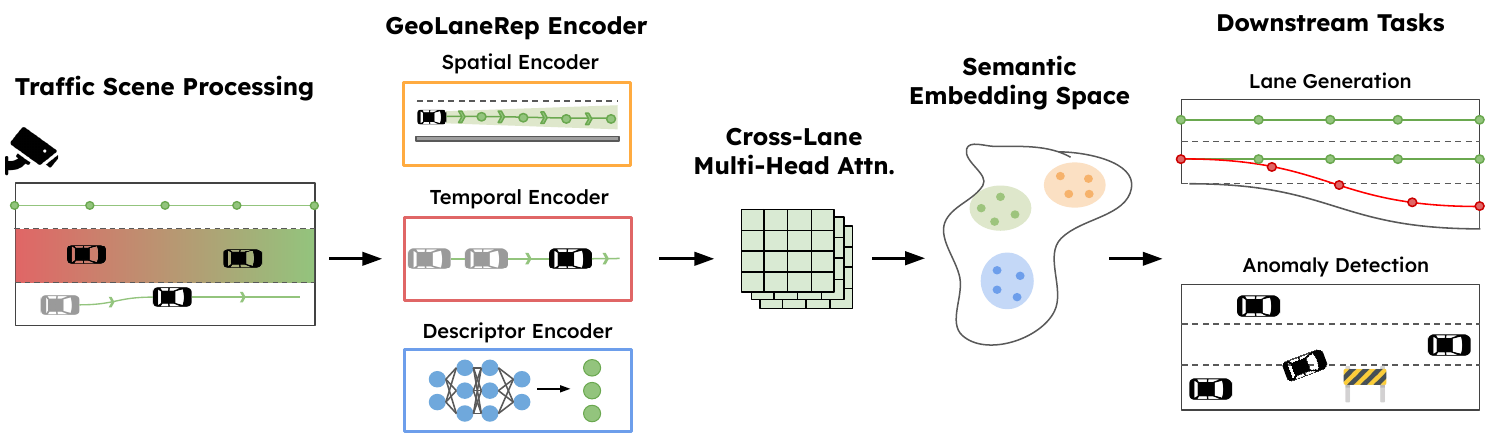
Traffic digital twins are powerful tools for advanced traffic management, and most systems are built on static geometric representations. However, these representations fail to capture the dynamic functional semantics required for behavior-aware reasoning, such as how a lane operates under complex traffic conditions. To address this gap, we introduce GeoLaneRep, a behavior-grounded lane representation learning framework for traffic digital twins. GeoLaneRep jointly encodes static lane geometry, observed vehicle trajectories, and operational descriptors into a shared, cross-camera semantic embedding. The encoder is trained with a joint objective combining contrastive cross-camera alignment, auxiliary role supervision, and temporal anomaly detection. Across 16 roadside cameras and 132 lanes, the learned embeddings achieve a 0.004 lateral-rank error and an edge-role F1 of 1.000 in zero-shot cross-camera matching, and an AUROC of 0.991 for window-level anomaly detection. We further show that the same behavioral embeddings can condition a diffusion-based generator to synthesize lane geometries that satisfy targeted operational specifications, with 87.9% overall specification accuracy across 38 lane groups. GeoLaneRep thus provides a semantic interface between roadside observations and downstream digital twin tasks, supporting cross-camera transfer, behavior-aware monitoring, and goal-directed lane synthesis. The framework is openly available at https://github.com/raynbowy23/GeoLaneRep .