Real-time lane-level abnormal traffic detection on freeways using sparse telematics data
Liang, S., Ma, C., Li, P., Shi, H., Liu, J., Zhou, H., Long, K., Cao, B., Szymkowski, T., Shi, X., & Li, X. (2026).
Accident Analysis & Prevention, 234, p.108607.
Abstract
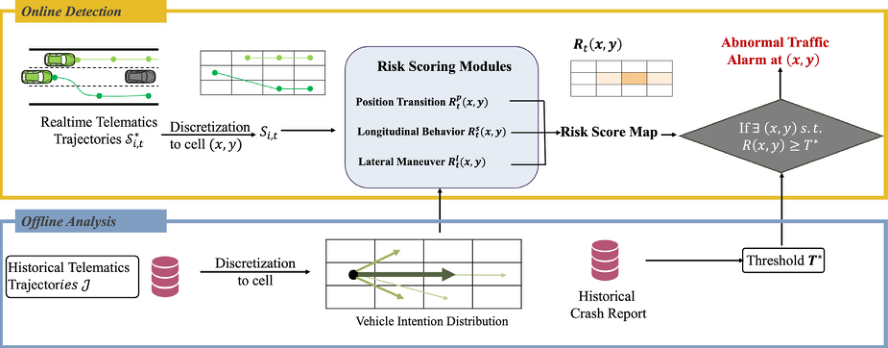
Real-time abnormal traffic detection is critical in intelligent transportation systems because traditional abnormal traffic notifications often suffer delays and lack specific, lane-level location information, which can lead to safety risks and economic losses. This paper proposes a real-time, lane-level abnormal traffic detection approach for freeways that only leverages sparse telematics trajectory data. In the offline stage, the historical trajectories are discretized into spatial cells using vector cross-product techniques, and then are used to estimate a vehicle intention distribution and select an alert threshold by maximizing the F1-score against official crash reports used as proxy labels for abnormal events. In the online stage, incoming real-time telematics records are mapped to these cells and scored for three modules: transition anomalies, speed deviations, and lateral maneuver risks, with scores accumulated into a cell-specific risk map. When any cell’s risk exceeds the alert threshold, the system issues a prompt warning. Relying solely on telematics data, this real-time and low-cost solution is empirically evaluated using these report-based labels in Wisconsin, achieving a 75% identification rate with accurate lane-level localization, an overall accuracy of 96%, an F1-score of 0.84, and a false alarm rate of only 0.6% among non-crash cases, while also detecting 13% of crashes more than 3 min before the notification time.